
When Children Have To Take On Responsibility – Parentification As A Hidden Risk
When Roles Shift: What Is Parentification?
Many families go through phases where children help out more than usual – for example, when a parent is ill or during a particularly stressful period. Short-term support can aid development and boost self-confidence. It becomes problematic, however, when a child permanently takes on tasks and worries that should actually fall to adults. Experts refer to this as parentification: children take on parental roles – whether visibly in household chores or invisibly in emotional support.
Such role reversals often go unnoticed because, to outsiders, they appear to be signs of ‘maturity’ or ‘helpfulness’. At the same time, they can place a long-term strain on the children’s emotional well-being. This guide explains what parentification means, how it arises, how to recognise it, and what short- and long-term consequences are possible. You will also learn what support is available and how the Verus Bonifatius Hospital supports those affected and their families.
Many people ask themselves: what exactly is parentification? It refers to a persistent role reversal in which children take on parental responsibilities – either practically in everyday life or emotionally when dealing with worries, conflicts or the emotional stabilisation of a parent. This differs from ordinary help with household chores: the key factors are duration, the extent to which the child is overwhelmed, and the unspoken expectation that the child will reliably take on caregiving or comforting roles.
The term is defined in various ways in the specialist literature, but at its core it always refers to the same pattern: the child manages needs that should actually be the responsibility of adults, and repeatedly puts their own age-appropriate development on hold to do so. In everyday life, the boundaries are fluid. It is therefore helpful to ask: Does the task empower the child – or does it lead to chronic overload, which silently forces them to ‘grow up’?
Forms: Instrumental and Emotional
In practice, a distinction is made between two main forms. Instrumental parentification means that children permanently take on adult responsibilities: looking after siblings, shopping, cooking, organising the household. This may be sensible in exceptional situations, but becomes problematic when it becomes the norm without sufficient relief being provided.
Emotional parentification is often particularly stressful: children become the constant point of contact, the comforter or conflict mediator; they listen to their parents’ worries, take on feelings of guilt, or are expected to stabilise the atmosphere at home. This hidden emotional labour is difficult for outsiders to recognise – and often difficult for the children themselves to put into words.
- Instrumental: Visible everyday and caregiving tasks that exceed the child’s age and capabilities.
- Emotional: Invisible emotional labour, conflicts of loyalty and the constant ‘caring’ for a parent’s emotional stability.
How Does Parentification Arise?
The development of parentification is usually the result of multiple factors. Triggers can include a parent’s illness – whether mental or physical – as well as addiction, separation and divorce, financial hardship, experiences of displacement or migration, and a lack of support from the wider social network. If a parent’s unresolved stress continues to shape everyday family life over a prolonged period, it is also worth taking a look at our article Trauma in parents – effects on children. Parental exhaustion syndrome can also push children into taking on responsibility without anyone realising – read more about this in the article Parental Burnout – Signs, Help, Treatment.
Not every instance of taking on extra responsibility leads to ill health. The decisive factors are the extent of the burden, whether it becomes chronic, and whether adults take back responsibility in a timely manner. Families who accept support and communicate openly usually protect their children better from being overwhelmed.
How Can Problematic Parentification Be Recognised?
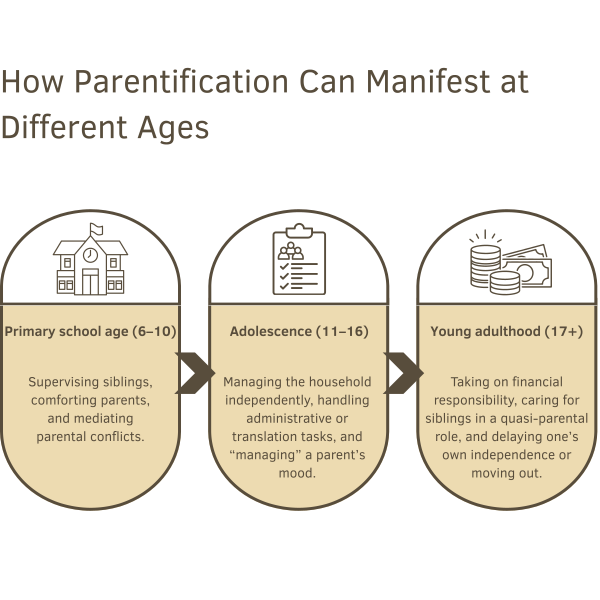
Taking on excessive responsibility manifests itself differently depending on age. It is important to draw a distinction: helping out is part of normal development – it becomes problematic when a child permanently assumes the role of a ‘little adult’, systematically puts their own needs on the back burner and experiences hardly any rest.
Many of those affected later report that they experienced the situation as ‘normal’ when they were children. This makes it all the more helpful to take a close look at warning signs and circumstances that may increase the risk.
Warning Signs in Children and Young People
Not every single sign necessarily indicates a disorder. It usually only becomes a cause for concern when several factors coincide over a period of months and the child’s well-being is visibly suffering. In such cases, it may be advisable to seek professional support.
- Premature adaptation
The child appears ‘too grown-up’, taking on planning and decision-making that should actually be the responsibility of the parents. - Persistent exhaustion or irritability
Exhaustion caused by responsibilities and inner tension that is not age-appropriate. - A decline in school performance or perfectionism
either a decline in performance due to being overwhelmed, or an excessive focus on achievement as an attempt to retain some sense of control, at least in that area. - Social withdrawal
fewer social contacts because the child is ‘needed’ at home or feels guilty about engaging in their own leisure activities. - Strong feelings of responsibility and guilt
the feeling of being responsible for their parents’ moods or conflicts.
Distinction: Maturity vs. Overburdening
Taking on responsibility can be healthy if it is age-appropriate, time-limited and accompanied by recognition and relief from the burden. It becomes problematic when responsibilities are structurally shifted onto the child, clear boundaries are lacking and adults withdraw. This can easily lead to a hidden imbalance that is barely noticeable from the outside.
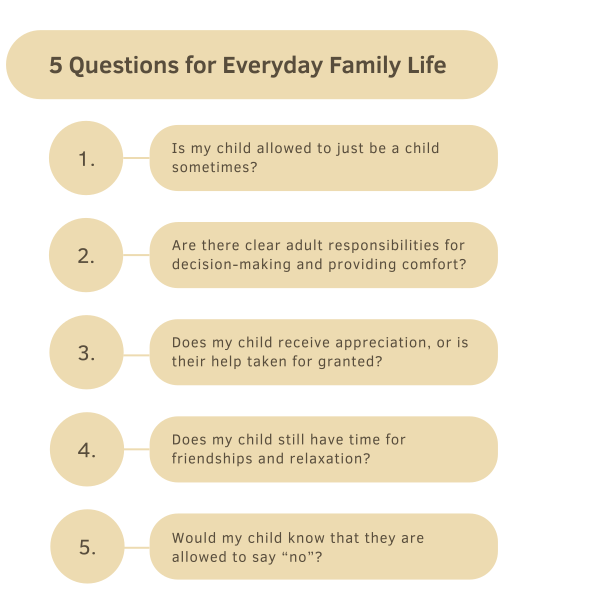
Helpful questions to ask in everyday life: Is the child allowed to simply ‘be a child’? Are there reliable adults who comfort, make decisions and provide for the child? Are the child’s needs recognised and taken seriously – or are they constantly put on hold?
Family Roles in Mother-daughter and Mother-son Relationships
Close one-to-one relationships, such as between mother and daughter or mother and son, are frequently described. It is not uncommon for girls to take on the quiet emotional labour, whilst boys tend to handle practical household tasks – these are trends observed in practice, not fixed rules. The individual family dynamics and the question of what relief is actually possible always remain decisive.
Such patterns help to recognise typical constellations, but they do not replace an assessment of the specific needs and resources of the family in question. If you are unsure whether the responsibilities in your family outweigh the child’s best interests, a discussion with specialists can provide clarity.
Confidential advice: information and contact details for the Verus Bonifatius Hospital
Short- and Long-term Effects
In the short term, parentification can certainly contribute to organisational skills, empathy and early maturity. At the same time, there is a risk that children will learn to define themselves primarily through achievement and caring for others. In adulthood, some affected individuals exhibit persistent patterns of over-adaptation, feelings of guilt and difficulties in maintaining their own boundaries.
The extent to which such consequences manifest themselves depends heavily on the individual case. Not everyone goes on to develop problems later in life – protective factors such as supportive caregivers, recognition and later experiences of correction have a balancing effect.
Mental Health
Potential long-term consequences primarily affect emotional self-care and stress regulation. Some adults experience persistent inner tension, struggle to accept help, or feel a vague sense of guilt as soon as they take their own needs seriously.
- Increased tendency towards exhaustion
Constant state of alertness can lead to sleep disturbances, irritability and physical complaints. - Anxiety and depression
The feeling of never having done enough, or the impression of being responsible for other people’s moods, can take its toll over time. - Difficulties with self-esteem and setting boundaries
Many people find it difficult to recognise and assert their own boundaries.
Relationships, Work and Everyday Life
In adult life, recurring relationship patterns often emerge: a tendency to rush to the aid of others, a propensity to take on the role of saviour in partnerships, or a tendency to avoid conflict at all costs. In the workplace, this can lead to burnout if finding it difficult to ‘say no’.
- Relationship: One-sided care, fear of rejection, conflicts of loyalty.
- Work: Perfectionism, difficulty delegating, exhaustion from constantly going the extra mile.
- Leisure: Feelings of guilt when relaxing, difficulty treating oneself.
Protective Factors and Corrective Experiences
Having reliable adults in one’s circle who provide support, as well as relationships later in life where care is mutual, can have a positive effect. Psychoeducation – that is, understanding one’s own patterns – helps to redefine one’s sense of responsibility: looking after oneself without letting others down. Even seemingly minor experiences can make a big difference, such as when someone realises for the first time that care is not something that has to be earned, but is simply a given.
If you recognise yourself in these descriptions, a conversation may help you to assess whether support is needed and, if so, what kind.
Arrange a confidential initial consultation now
What You Can Do Yourself: First Steps and Boundaries
Self-help measures are no substitute for therapy, but they can provide initial guidance. It is important to adopt a supportive attitude – towards yourself and everyone involved: parentification rarely stems from malice, but usually from being overwhelmed and a lack of resources. At the same time, clear decisions are needed to provide children with tangible relief.
Please note: Persistent stress, significant psychological distress or signs of symptoms requiring treatment – such as severe anxiety, depressive episodes, self-harm or addictive behaviour – are clear indications that professional help should be sought. In such cases, a medical and psychotherapeutic assessment at the Verus Bonifatius Hospital can provide vital support.
For Parents and Carers
Talk openly and in an age-appropriate way with your child: thank them for the help they have given, set clear boundaries (“That’s a job for grown-ups”) and actively organise support – for example, through family, friends, youth support services or counselling centres. Schedule fixed, child-free times and ensure that your child gets enough sleep, leisure time and social interaction.
- Clear roles
Who makes decisions, offers comfort, organises things? The adults should agree on these responsibilities. - Organising support
Quick access to help is more important than perfection. Small, reliable steps count for more than the grand plan. - Allowing feelings
Children are allowed to feel sad, angry or exhausted – without feeling guilty about it.
For Adults Affected
If you recognise yourself in typical patterns – constant caregiving, difficulty setting boundaries – it can help to consciously practise ‘inner permissions’: taking breaks is allowed, your own needs are legitimate, and ‘no’ is already a complete sentence. Therapy can help you to redefine your sense of responsibility and work through potential consequences stemming from your childhood in a targeted way.
- Be mindful of boundaries
Take physical signals such as tiredness or tension seriously as stop signs. - Seek support
Therapy, group support or trusted adults – seeking help is a sign of strength, not a failure.
School, Youth Support Services and the Wider Environment
Professionals in schools and youth support services can raise awareness without stigmatising. Offers of support, adjustments to learning, and the provision of appropriate help often bring noticeable relief to children – sometimes simply having a regular point of contact outside the family is enough to ensure a child no longer feels left alone. Confidentiality and data minimisation help to maintain trust, whilst clear agreements between the school, youth support services and the family protect everyone involved and prevent unnecessary duplication of effort.
Acute Warning Signs
If there are indications of self-harm, severe neglect, violence or addiction within the household, professional support is needed immediately – in such cases, do not wait to see if the situation improves on its own. In acute crises, contact the emergency medical services, the out-of-hours medical service on 116 117 or the emergency number 112. The local youth welfare office or a child protection clinic can also provide rapid assistance and help determine what steps to take next.
If you notice any acute warning signs, do not hesitate to seek additional professional advice.
Take a look now at the treatment options and contact details for the Verus Bonifatius Hospital.
Diagnosis and Treatment at the Verus Bonifatius Hospital
The Verus Bonifatius Hospital offers a safe environment in which to understand stressful role patterns and explore new approaches. The aim is not to assign blame, but to distribute responsibility more fairly and to strengthen existing resources. Depending on age and individual needs, we work with individuals, families or in groups.
Treatment is tailored to the individual’s specific circumstances: is the parentification predominantly instrumental or emotional? Are there accompanying mental health issues such as anxiety, depressive symptoms or physical consequences of stress? The process therefore begins with a thorough medical history, supplemented by questionnaires or diagnostic interviews. Psychoeducation clearly explains what parentification means, how it arose and which patterns it perpetuates in the family’s everyday life – in this way, we jointly develop a language for what has often previously been experienced merely as a vague feeling of being overwhelmed.
Depending on individual needs, we combine the following therapeutic components:
- Behavioural therapy (individual and group therapy)
Self-care, setting boundaries, issues of guilt and new role models are explored in a very practical way, using situations from the everyday lives of those affected. - Family therapy intervention
Family and parent consultations help to allocate responsibilities in an age-appropriate way, defuse conflicts of loyalty and reach agreements that ease the burden of everyday life. - Problem-centred group therapy
Through interaction with others in similar situations, social skills are developed and a sense of not being alone with one’s own story is fostered. - Relaxation techniques
Mindfulness and relaxation techniques help to reduce inner tension and develop new ‘stop signals’ for everyday life. - Body, art and music therapy
Those who find it difficult to put their distress into words often benefit from processing it through physical and creative means.
Depending on the patient’s age, we also consider school- or work-related issues: How can they successfully return to school or work, or adapt to new demands, without old patterns resurfacing? At the end of a stay, we plan specific follow-up steps together – such as outpatient psychotherapy in their home town, local counselling centres or supportive group programmes – to ensure that the stabilisation achieved carries over into everyday life at home.
Get in touch now for a no-obligation consultation
FAQ
Is Parentification Always Harmful – or Can It Also Be Empowering?
Taking on additional responsibility in the short term can certainly help to develop skills and self-confidence. It becomes problematic, however, when the role reversal is permanent, overwhelms the child and no relief is provided. In such cases, long-term consequences in adulthood are also more likely. Protective factors such as reliable adults and later experiences that help to correct the situation significantly reduce the risk.
How Do I Talk to My Parent About Past Role Reversals Without Triggering Feelings of Guilt?
Choose a quiet moment and speak in the first person (“I often felt that back then…”). Describe the impact it had on you rather than making accusations, and explain what would help you today. Therapeutic support can help structure such conversations and prevent old patterns – such as emotional parentification – from being reactivated unnoticed.
Does Parentification Occur Only in Biological Families – or Also in Blended and Foster Families?
Role shifts can occur in all types of family. Transitions such as separation, new partnerships, or foster and adoptive arrangements present particular challenges. In every case, it is important to clearly agree on responsibilities and to actively relieve the burden on children – regardless of whether the family constellation is mother-daughter, mother-son or any other.
Published on: 14.08.2026