
Toxic Relationships – Why We Stay Even Though They Harm Us
When Closeness Hurts: What Defines a Toxic Relationship
There are relationships that appear unremarkable from the outside but wear you down from within. You carry on as normal, go to work, meet up with friends, laugh at family gatherings – and at the same time feel a tension that does not ease even in the evenings. It is precisely this discrepancy between the façade and the lived experience that is so characteristic.
The term “toxic relationship” is not a diagnosis, but a description. It does not refer to a difficult phase or a single argument, but to a recurring pattern of belittling, control, blame-shifting and abrupt shifts between closeness and coldness. In this article you will read how to recognise such patterns, why leaving a relationship like this is so difficult psychologically, what traces prolonged relationship stress leaves in body and mind, which steps can give you clarity, and what professional treatment involves.
What Is a Toxic Relationship – And What Is It Not?
What is a toxic relationship? In short: a partnership in which patterns of communication and behaviour are persistently hurtful and intensify without deliberate countermeasures. These include blame-shifting, gaslighting – the systematic questioning of your perception – controlling behaviour, cutting you off from friendships or financial independence, threats, and gruelling cycles of separation and reconciliation.
The counterpart to this is perfectly ordinary conflict. Differing needs and arguments about money, parenting or closeness are part of every relationship. The difference lies not in the volume, but in what happens afterwards: after a normal argument things are cleared up, apologies are made, something changes. In a toxic dynamic the pattern stays the same – only the explanations change. And a second point applies just as much: toxic does not automatically mean beyond saving. Where there is physical or severe psychological violence, however, safety takes precedence over any attempt to rescue the relationship.
The Cycle of Idealisation and Devaluation
Many of those affected describe ups and downs that feel almost predictable: phases of particular affection – attentive messages, shared plans, the feeling of finally being understood – are followed by coldness, scenes of jealousy or days of silence. If the conflict is addressed at all later on, it is framed as a “misunderstanding” or as a reaction to your own behaviour.
This reinterpretation is where the real damage lies. Anyone who hears for months on end that their own memory is wrong will eventually lose access to their own judgement. This is exactly where the typical on-off relationship takes shape: every reconciliation feels like a fresh start and, for a short while, overwrites everything that happened before.
Recognising a Toxic Relationship: The Most Common Warning Signs
A single sign means nothing on its own – no one has a relationship without hurtful moments. You should take notice when several of these points accumulate over weeks and months, and especially when people around you say that you have changed.
- Boundary violations are dismissed as jokes
Derogatory remarks about your appearance, your job or your family end with “I was only joking” – and you are the one with no sense of humour as soon as you bring it up. - Control takes the place of trust
Checking your location, looking through your phone, comments on every arrangement you make, or a joint account that in practice only one person accesses. - Your perception is systematically cast into doubt
Conversations you remember clearly are said never to have taken place. You start saving messages in order to be sure of your own version. - Separation and reconciliation follow a weekly rhythm
An on-off relationship with many fresh starts creates permanent alertness; genuine calm never sets in. - Your body reacts before your mind does
Sleep disorders, pressure in the stomach or a tightness in the chest as soon as the key turns in the door. - Your world gets smaller
You cancel arrangements to avoid arguments. After a year your circle of friends has shrunk to two contacts.
When a Narcissistic Personality Disorder Is Involved
Not every hurtful behaviour has clinical significance, and no diagnosis can be made from a distance. Even so, it is worth looking at a pattern that comes up very frequently in counselling: narcissistic personality disorder. It is more than pronounced self-centredness. At its core lies a very fragile sense of self-worth that has to be stabilised through constant admiration – criticism is then not experienced as an opinion but as an attack, and is answered accordingly. Clinically, the following are described, among others:
- an inflated self-image combined with a strong sensitivity to criticism
- markedly limited empathy for the feelings of others
- a persistent need for admiration and validation
- alternating between idealising and devaluing the same person
- great difficulty in acknowledging one’s own part in conflicts
In the end, the label matters less to you than the question of how you are faring in this relationship. A narcissistic personality disorder is diagnosed by specialists, and specifically in the person affected. You can read about how such patterns are treated on our page on personality disorders.
Why We Stay: The Mechanics Behind Holding On
“Why don’t you just leave?” is the question those affected hear most often – and the one that helps least. It assumes that staying is a free, well-informed decision. In reality, mechanisms are at work here that are very fundamental and have little to do with willpower. Three forces interlock: a learning pattern that keeps recharging hope, a shrinking sense of self-worth, and very practical dependencies.
Intermittent Reinforcement: Why Rare Good Moments Bind So Strongly
Behavioural psychology tells us that a reward which arrives reliably binds less strongly than one which arrives unpredictably. This principle – intermittent reinforcement – explains why people stay sitting at slot machines, and it explains a large part of what happens in a toxic relationship. After two weeks of coldness, suddenly there is the evening when everything falls into place: the long conversation, the apology, the weekend that feels like it used to. It is precisely the unpredictability that makes these moments so valuable – and the bond so tenacious.
Added to this are patterns of thinking familiar to us all. We justify what we have invested (“You don’t throw away seven years”), we play down warning signs (“He has a lot on his plate at work right now”), and we preferentially remember the exception rather than the rule. In an on-off relationship this is reinforced further: every reconciliation continues the story of a low point weathered together and distracts from the fact that the low point reliably returns.
Part of this bond is described as a trauma bond. Cycles of tension, escalation and subsequent relief create very intense feelings of closeness – often the most intense someone has ever experienced. These feelings are real. They simply say nothing about whether the relationship is good for you.
When Self-Worth Shrinks Along With It
Constant devaluation works slowly. It rarely begins with an insult, but with sentences you eventually say to yourself. Many of those affected recognise themselves in thoughts such as:
- “I’m just too sensitive.”
- “If I behave differently, things will settle down.”
- “It’s not that bad – others have it harder.”
- “Who else would want me?”
What is happening here is a shift of responsibility inwards. Anyone who believes they are the problem does not look for help, but tries to optimise themselves. Shame is added to this: talking about a relationship you once consciously chose feels like an admission. This shame keeps many people in the situation for longer than the relationship itself does.
The Practical Ties: Home, Money, Responsibility
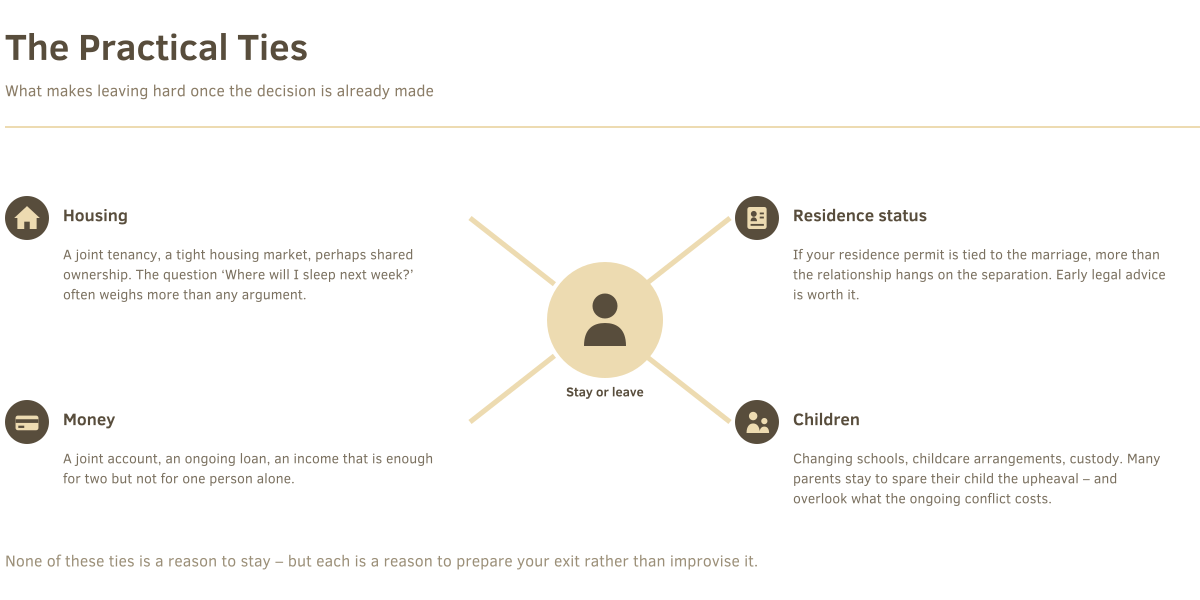
Alongside the psychology there are very tangible reasons: a shared flat in a tight rental market, an ongoing loan, a residence permit tied to the marriage, a child who should not have to change schools. Some of those affected also fear – often justifiably – that it is the separation itself that will trigger aggression. That is no reason to stay, but a very good reason to prepare your exit rather than improvise it. Anyone who knows which counselling services, legal routes and therapeutic options exist is no longer choosing between enduring the situation and a leap into the void.
What Prolonged Relationship Stress Does to Mind and Body
The body does not distinguish between real danger and a situation in which you permanently expect conflict. Living in a state of alert for months comes at a cost – often long before the relationship itself comes into view as the cause. It is not uncommon for people to seek treatment for sleep problems or stomach complaints and only mention their relationship in the third session.
Psychological Consequences – And Where the Line to Illness Runs
Typical signs are persistent low mood, irritability, loops of rumination, problems concentrating and a feeling of inner emptiness. Many describe having become strangers to themselves: interests have disappeared, decisions are difficult, even a dental appointment takes an effort. Depending on duration and severity, the risk of depression, anxiety and panic disorders or functional and psychosomatic complaints can increase.
Not every strain requires treatment. We speak of an illness when symptoms persist for several weeks, clearly restrict everyday life or grow worse – that is, when you are not merely exhausted but can barely meet your obligations. A structured diagnostic assessment creates clarity in both directions: it can identify an illness, but it can equally provide relief by showing that your reaction is an appropriate answer to an untenable situation. Incidentally, chronic devaluation works no differently in a relationship than it does at work: the long-term psychological consequences of bullying follow the same pattern of tension, withdrawal and dwindling self-confidence.
What the Body Carries
Chronic stress keeps the autonomic nervous system permanently activated. The consequences are non-specific and are therefore often explained differently for a long time:
- difficulty falling asleep and staying asleep, waking early
- muscular tension, headaches and back pain
- gastrointestinal complaints with no organic findings
- palpitations, tightness in the chest, shallow breathing
- changes in appetite, frequent infections
Socially, a second pattern emerges: withdrawal, secrecy, avoiding questions. Those around you often do not understand why someone “just doesn’t leave” and react with impatience – which reinforces the isolation further. It helps to deliberately confide in two or three people rather than waiting until everything can be explained. If physical complaints persist without any organic findings, specialists refer to functional cardiovascular and gastrointestinal disorders – highly treatable, but rarely resolved by rest alone.
Ways Out: Gaining Clarity, Setting Boundaries, Leaving Safely
Not every distressing relationship has to end immediately. Sometimes something changes when boundaries become clear and both sides work on them. Sometimes leaving is the only viable path. Both begin at the same point: with a sober assessment that you carry out calmly rather than in the middle of an argument.
Learning to Believe Yourself Again
When your own perception has been called into question for months, good intentions will not help – documentation will. This is not about gathering evidence against someone, but about regaining your own judgement.
- Keep a brief log for four to six weeks
Note down in keywords what happened, how you felt afterwards, and how long it took you to recover. Patterns only become visible in hindsight. - Define your boundaries in writing before you voice them
What is no longer negotiable for you – and what consequence follows if it happens again? A boundary without a consequence is a request. - Review your resources in concrete terms
An account of your own, access to important documents, a place where you could stay at short notice. Much of this can be sorted out calmly, long before it is needed. - Bring in an outside perspective
A counselling service, your GP or a psychotherapy consultation can put into context what is almost impossible to assess from the inside.
Setting Boundaries Without Escalating
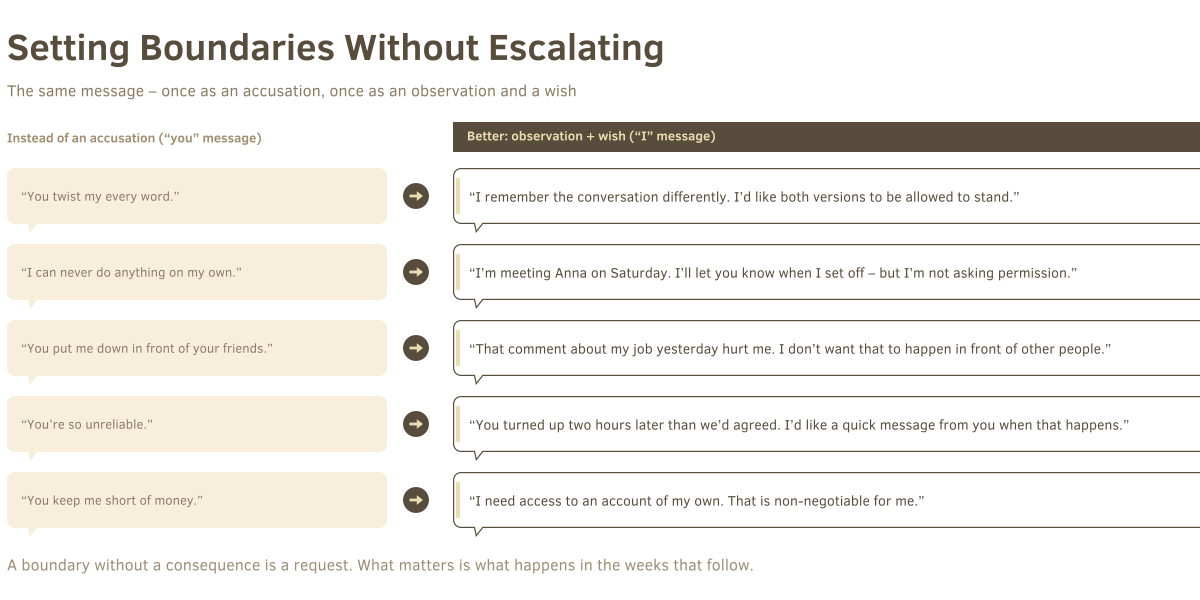
A conversation about boundaries rarely succeeds spontaneously in the middle of a conflict. Choose a calm moment, stay with what is observable rather than with character traits, and use “I” messages: “When you check my phone, I lose trust. I want that to stop.” This is considerably more effective than “You are so controlling”, because there is nothing to dispute.
What matters is what happens in the weeks that follow. Reliable change shows itself in behaviour, not in assurances – and it holds even when you do not remind anyone of it. If everything stays as it was and the cycle repeats, that is information, not a personal defeat. If you notice that you are only having conversations in order to avoid escalation, the point for professional support has been reached.
Ending a Toxic Relationship – Despite Love
The hardest case is not the one in which nothing is left. It becomes difficult when affection and harm exist side by side. Many people want to end a toxic relationship despite still loving their partner – and take that for a contradiction. It is not: love is no proof that a relationship is sustainable. Ambivalence is part of it. You are allowed to grieve and at the same time know that the step is the right one.
A planned separation lowers both the risk and the likelihood of returning. It has proved worthwhile to clarify these points beforehand:
- Finances: your own account, an overview of joint contracts and loans.
- Housing: a realistic place for the first few weeks, a clarified tenancy situation.
- Documents: ID, insurance papers and birth certificates to hand.
- Legal matters: an initial consultation with a solicitor, particularly where children or joint property are involved.
- Support: two or three people who are informed and remain reachable.
- Rules on contact: decide in advance whether and how you will communicate – the most common route back is the midnight phone call.
Where threats, stalking or physical violence are involved, a different order applies: safety first, everything else later. In acute danger, dial 112. For mental health crises outside practice hours, the German out-of-hours medical service can be reached on 116 117, and the “Violence Against Women” helpline is available round the clock on 116 016. For acute stabilisation, our crisis intervention is also available to you.
When There Are Children in the House
Children register tension even when no one argues in front of them – they simply explain the atmosphere to themselves differently, usually by blaming themselves. Constant ups and downs are particularly hard for them to make sense of: a child who does not know whether a parent will be there this evening develops vigilance instead of trust. What helps is less the perfect explanation than a reliable framework: consistent routines, clear responsibilities, age-appropriate information without pressure to take sides.
In such constellations children also slip quickly into a role that is not theirs to carry: they comfort, mediate between the parents and hold everyday life together. Unresolved strains carried by parents are passed on in this way too, without ever being talked about. If you are unsure how your child is doing, seek advice early – there are dedicated treatment options for children and adolescents.
How the Verus Bonifatius Clinic Provides Support
People who have lived for years in a distressing relationship rarely come to us with a single question. Usually it is exhaustion, self-doubt, sleep problems and the open decision about how to go on, all at once. At the Verus Bonifatius Clinic in Bad Salzschlirf, treatment therefore begins with a detailed diagnostic assessment by our interdisciplinary team from psychology, psychiatry and psychosomatic medicine. We clarify which symptoms are most prominent, whether a depressive episode, an anxiety disorder or psychosomatic symptoms have developed, and which stress factors are currently at work. Where features of a narcissistic personality disorder in your partner play a role, we put this into context without labelling prematurely – the focus is on your situation, not on a remote diagnosis of someone who is not in treatment.
A distinctive feature of our clinic is parent-child therapy: you can bring your child with you, and child companionship is provided on site. Particularly for single parents or parents in the middle of a separation, this removes the most common reason for postponing treatment again and again. Depending on the findings, we combine the following elements:
- Behavioural therapy (individual and group)
The focus is on dealing with feelings of guilt, recognising your own patterns and rebuilding self-worth and the ability to set boundaries. - Depth psychology (individual and group)
Works on the biographical roots of attachment patterns – helpful when similar constellations repeat across several relationships. - Problem-centred group therapy
Exchange with others in the same situation counteracts shame and makes setting boundaries something you can practise in a protected space. - Crisis intervention
Where things come to a head acutely, for instance after an escalation or a separation, short-term stabilisation takes priority. - Body awareness, mindfulness and progressive muscle relaxation
Lowers permanent physical tension and restores access to your own signals. - Body, art and music therapy
Non-verbal approaches for everything that cannot yet be put into words. - Family therapy intervention
For family systems in which children are also affected – with a focus on stability and on easing the parental role.
We recommend couples therapy only under two conditions: a willingness to change on both sides and a safe setting. Where violence or threats are present, it is not the right route – there, protection comes before clarification.
The transition back into everyday life is prepared for and not left to chance. Before discharge we work out together the ongoing outpatient treatment, suitable counselling services where you live and, if a separation lies ahead, the next very practical steps. Looking back, many patients describe that it was not a single session that made the difference, but the experience of living for several weeks in an environment in which their perception was not called into question.
FAQs
Is This Still a Difficult Partner or Already a Toxic Relationship?
The difference lies less in the individual argument than in the course things take. In a difficult but healthy relationship there is clarification, apology and a change in behaviour – the conflict comes to an end at some point. It becomes toxic when hurtful patterns become entrenched: repeated boundary violations, blame-shifting, a climate of fear and caution, social withdrawal, devaluing language, and cycles of separation and reconciliation without lasting change. A practical guide: ask yourself how much time you have spent in recent months avoiding conflicts rather than resolving them. If you remain unsure, have your situation assessed in a counselling session or a psychotherapy consultation.
Can a Toxic Relationship Become Healthy Again?
Sometimes yes – if both sides recognise the patterns, take responsibility for their own part and work reliably on change. This requires clear boundaries, binding agreements, frequently both couples therapy and individual therapy, and above all time. What is decisive is whether change holds even when no one reminds anyone of it. Where violence, threats or severe devaluation are involved, this does not apply: there, protection comes first, and separation is the safer path. If you are wavering between trying again and ending the relationship, a professional assessment helps more than any list of pros and cons.
How Do I Support Someone Close to Me Who Does Not Want to Leave?
Signal reliability without pressure. Sweeping judgements about the partner usually lead the person to defend them and to tell you less. It is more effective to stay with observations and feelings: “I can see how exhausted you are, and I’m worried.” Offer concrete help – accompanying them to a counselling appointment, childcare, gathering information. And expect ambivalence: the path out of such a relationship is almost never a straight line. Stay reachable, even if someone goes back at first. In acute danger, help them make contact with emergency services or protection services.
This guide is not a substitute for individual diagnosis or therapy. If symptoms persist or worsen, please seek professional support.
Published on: 12.11.2026