
Understanding Obsessive Thoughts – When Your Mind Won’t Let Go of Everyday Life
What Obsessive Thoughts Are – and What They Aren’t
Obsessive thoughts are intrusive, recurring thoughts, images or impulses that are experienced as distressing, inappropriate or frightening. Typically, they cannot simply be pushed aside and are perceived as alien – as something that does not fit with one’s own values. Many people affected describe a strong inner urge to neutralise these thoughts: by calming themselves down, by checking, or through small rituals that nobody else notices.
Most people are familiar with brief, intrusive thoughts. A condition requiring treatment is only considered to exist when the frequency, intensity and impact on daily life increase significantly – in other words, when sleep, work, school, relationships or one’s own health are noticeably affected. On this page, you can read about how to recognise the transition from normal worrying to obsessive-compulsive disorder, how persistent obsessive thoughts change one’s life, what you can do yourself, and what professional treatment involves.
Typical Content – Why the Content Is Rarely the Problem
In terms of content, obsessive thoughts vary greatly. They often revolve around the fear of harming someone, becoming contaminated, acting in a morally wrong way, or overlooking something irreversible. It is precisely because these thoughts contradict one’s own values that they trigger such intense anxiety: a loving mother is deeply alarmed by the fleeting thought that something might happen to her baby because of her – and it is precisely this alarm that indicates the thought says nothing about her intentions.
From a professional perspective, therefore, it is not so much the specific content that matters as the way a thought is evaluated and what happens afterwards. We encounter these issues particularly frequently in everyday clinical practice:
- Doubts about causing harm and responsibility
The worry of having accidentally hurt or endangered others – for example, whilst driving, cooking or looking after their own child. This often leads to compulsive checking. - Contamination and purity
Fear of germs, dirt or the transmission of disease, leading to extensive washing and cleaning rituals, sometimes to the point of compulsive washing. - Religious and moral doubts
Repeatedly questioning whether a statement, thought or action was wrong, often accompanied by silent attempts at making amends. - Relationship and identity doubts
Tormenting deliberations over whether a relationship, a career or a decision is really the right one – without any answer ever being satisfactory.
Normal Worry, Obsessive Thought, Compulsive Behaviour
Normal worries are linked to a specific situation and can be put into perspective over time: the bill is paid, the conversation is over, the tension eases. Obsessive thoughts, on the other hand, persist, jump from one topic to another and crop up precisely when you least need them. The key factors are the perceived lack of control, the intense unease and the loss of time caused by mental or behavioural countermeasures.
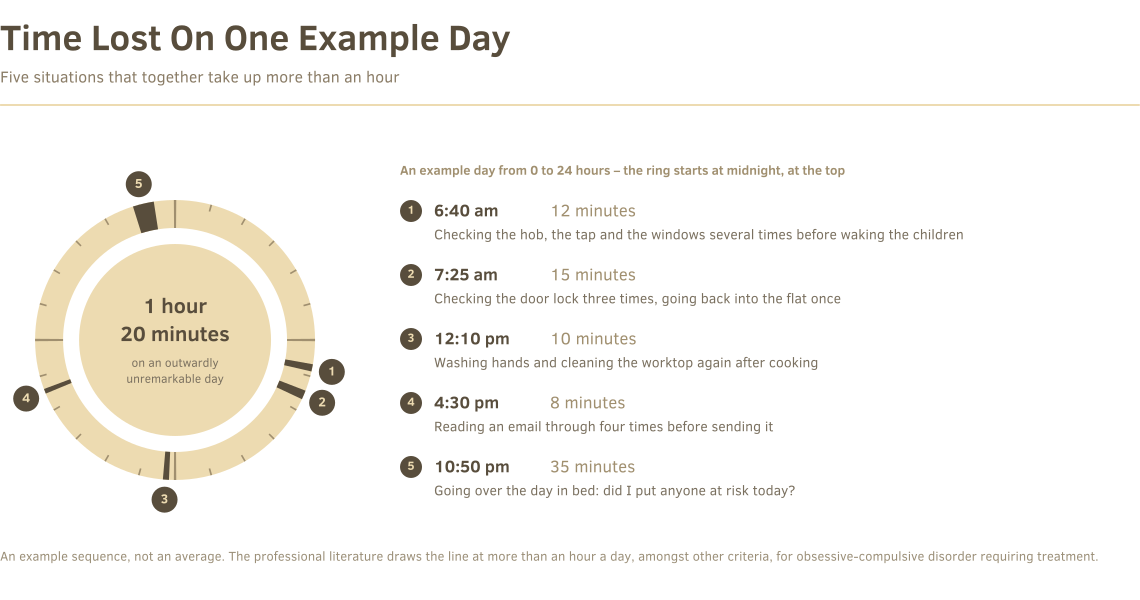
Not everyone affected develops visible compulsive behaviours. When they do occur, they almost always serve to reduce the unease in the short term – for example, through compulsive checking of the hob and door locks or compulsive washing for several minutes at a time. This works in the short term, but in the long term it reinforces the cycle: the thought gains more weight, and the next act of checking becomes more likely. Purely mental rituals – counting, praying silently, repeating phrases – have the same effect, but remain invisible to outsiders. This is precisely where modern psychotherapy comes in.
How Obsessive Thoughts Arise: Causes and Risk Factors
There is no single cause. Biological, psychological and social factors interact. Neurobiologically, networks between the prefrontal cortex and the basal ganglia are involved; these are responsible for evaluation, impulse control and error processing. Pharmacologically, serotonin mechanisms play a role, which helps to explain why certain antidepressants are effective for obsessive-compulsive symptoms. Such models do not account for an individual’s life story, but they do help to put feelings of shame and self-blame into perspective – nobody chooses these thoughts voluntarily. Psychologically, a learning cycle also develops: if avoidance or rituals are perceived as protecting against something bad, the behaviour is reinforced and repeated. Contributing factors include, amongst others:
- a strong sense of conscientiousness and perfectionism
- a low tolerance for uncertainty and ambiguity
- a strongly internalised sense of responsibility
- prolonged stress or stressful life transitions such as parenthood, starting university or changing jobs
- life experiences in which a strong emphasis was placed on being faultless
- a family history of obsessive-compulsive or anxiety disorders
The key to treatment is not to find a single trigger, but to facilitate new experiences: thoughts are allowed to be there without necessarily having to be followed by a ritual.
How to Recognise When Rumination Is Turning Into an Obsession
The transition is gradual, and that is precisely what makes it difficult to identify. Many people affected continue to function without arousing suspicion for a long time and only realise late on just how much time and energy their thoughts are already consuming. It is therefore helpful to focus less on individual thoughts and more on the pattern behind them.
The Internal Cycle: Trigger, Evaluation, Countermeasures
From a clinical perspective, distress does not arise from the thought itself, but from how it is evaluated (“If I think that, it might actually happen”) and the subsequent reaction. The sequence is surprisingly similar across a wide range of issues:
- A thought intrudes, often without any apparent cause.
- It is assessed as threatening or significant.
- This is followed by checking, questioning, seeking reassurance or avoidance.
- The short-term relief reinforces the pattern – next time, the impulse arises more quickly.
This cycle is exacerbated by stress, lack of sleep, heavy responsibilities and periods of exhaustion. The constant availability of information also plays a role: anyone who can look something up whenever they have a doubt is practising the exact opposite of tolerance for uncertainty. In the case of contamination-related compulsions, it is often smells, physical sensations or media reports about pathogens that trigger the urge.
Warning Signs That Professional Help Is Advisable
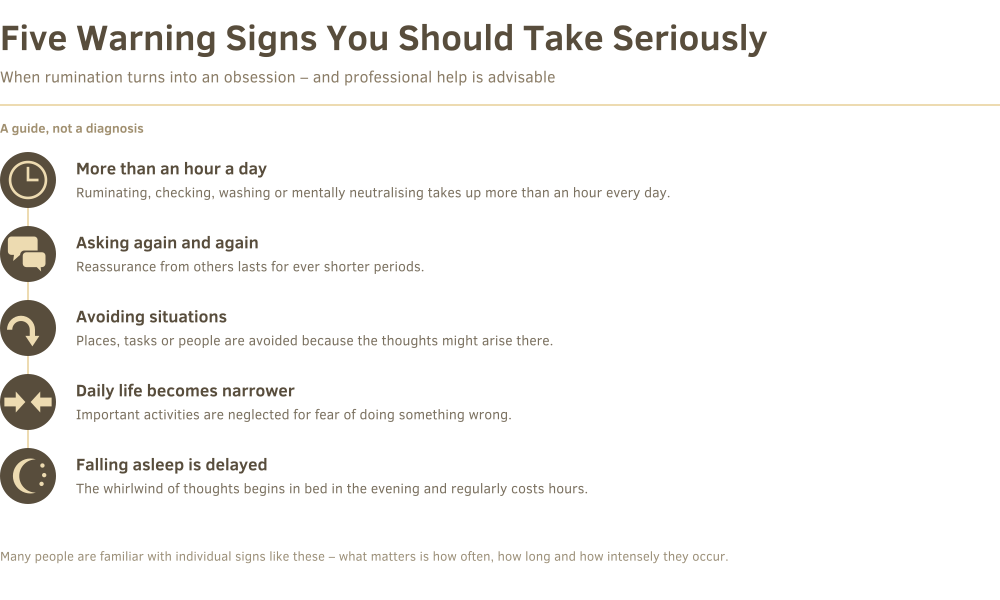
Treatment is required if obsessive thoughts persist for weeks, cause significant distress or lead to avoidance and time-consuming rituals. Obsessive-compulsive disorder often progresses in phases and changes over time – which makes it all the more important to recognise your own patterns early on. You should take the following signs seriously:
- Lost time
You spend more than an hour every day ruminating, checking, washing or mentally neutralising. - Repeated reassurance-seeking
You keep asking loved ones whether everything is really all right – and the reassurance lasts for ever shorter periods. - Avoidance
You avoid places, tasks or situations because typical thoughts might arise there. - Restriction of daily life
Important activities are neglected because the fear of doing something wrong has become too great. - Sleep problems
The whirlwind of thoughts begins in bed in the evening and regularly delays falling asleep by hours.
The first step is to seek a medical or psychotherapeutic assessment. GPs, paediatricians and specialists in psychiatry and psychotherapy are suitable points of contact; in the event of an acute crisis, you can contact the German medical out-of-hours service on 116 117, or dial 112 in an emergency.
When Children and Young People Are Affected
Obsessive-compulsive disorder in children and adolescents often manifests itself differently than in adults. Rituals are disguised as play; prolonged periods spent on homework conceal constant checking; and questions about right and wrong become conspicuously frequent. Some children only show signs of the condition at home and maintain a façade at school with great effort – this takes energy that is then lacking elsewhere.
It is difficult for parents to tell the difference, as rituals in childhood can also be a normal part of development. A good guide: developmentally typical rituals provide a sense of security and can be negotiated, whilst compulsive rituals cause panic as soon as they are interrupted. Involving parents is central to treatment – not to exert more control, but to reduce the need for reassurance and to support their child in taking courageous steps. Treatment started early and tailored to the child’s needs significantly improves the prognosis.
How Persistent Obsessive Thoughts Change Your Life
As the burden increases, obsessive thoughts begin to affect decision-making, time management, social contacts and quality of life. Many people affected describe it as a loss of mental freedom: the mind is constantly preoccupied with something one has not chosen.
Exhaustion, Sleep and Psychological Consequences
Constant tension takes its toll. This often leads to sleep disorders, problems concentrating, headaches, gastrointestinal complaints or a constant sense of inner restlessness. Because the constant stream of thoughts demands attention, performance levels drop – which in turn fuels further self-doubt.
It is not uncommon for a depressive mood to set in, particularly if the condition persists for months and those affected develop a feeling of no longer being able to trust themselves. Shame also plays a major role: because the content of these thoughts often seems embarrassing or frightening, many people do not talk to anyone about it for years. If you would like to strengthen your own resilience, you will find suggestions in our article on resilience in professional and personal life.
When Family, Work and School Are Affected
Obsessive thoughts rarely remain a private matter. Family members are drawn into rituals; they are expected to reassure, validate or take on tasks that those affected avoid. This happens out of love – yet it nevertheless reinforces the symptoms. Relationships come under strain; children perceive their parents as tense and difficult to reach; siblings quietly conform to the rules dictated by the compulsion.
At work, the strain often manifests as a slowdown: tasks are checked repeatedly, emails are read over and over again, and decisions are postponed. At school and university, constant checking takes up study time that is then lacking for the subject matter. We also describe just how much additional strain a daily routine that has lost its balance can cause in our article on mental stress caused by a lack of work-life balance.
Request our free information pack now and take your time to read about what a stay with us involves
What You Can Do Yourself
Anyone who wants to get rid of obsessive thoughts usually wishes they could simply switch them off. That is understandable, but not realistic. What can be changed is how you deal with them: ritualise less, view them differently, act differently. The following steps are no substitute for treatment, but they can provide noticeable relief and help you get through the period until therapy begins.
What Helps in the Short Term – and What Is Realistic
Small, repeatable counter-impulses are effective, not grand resolutions. The mindset behind them is important: you are not trying to banish the thought, but to reduce its power.
- Write it down and put it into context
Note down the thought, the time, the trigger and your reaction. This creates some distance and reveals patterns that remain invisible in your mind. - Pause briefly instead of reacting immediately
Focus on three to five breaths and only then decide how you want to act. Even this brief pause breaks the automatic response. - Consciously finish the everyday task
Finish washing the cup without checking the hob again. A small, clearly defined step is more effective than a grand resolution. - Kind self-talk
“A thought is just a thought – nothing more.” This is not mere reassurance, but a realistic reassessment. - Stabilise the basics
Sufficient sleep, exercise and a reliable daily routine reduce underlying tension and thus the frequency of these impulses.
What Often Doesn’t Help – Despite Good Intentions
Some things provide temporary relief but exacerbate the problem over weeks. Repeated checking reinforces the very message that without it, things are unsafe; frequent cleaning rituals heighten the perception of danger. The search for absolute certainty is particularly treacherous – in principle, it cannot be found.
- endless research into symptoms, risks and safety issues
- repeatedly asking family members whether everything is really all right
- avoiding situations in which the thought might arise
- alcohol or sedatives for quick relief
- attempting to consciously suppress the thought – this causes it to return more frequently
Staying on Track: A Personal Early-Warning Plan
Once you have seen an initial improvement, consistency is key. It helps to have a written plan that answers three questions: What signs tell me that my tension is rising? What small steps can I practise then? Who do I turn to, both personally and in therapy? If you establish these answers during calm periods, you will not have to search for them when things get turbulent.
Consciously factor in fluctuations: setbacks are not a relapse to the initial state, but usually just indicate which situations require further practice. And set yourself end points – check once, then move on. A checklist with a clear end point sets boundaries for rituals more effectively than the resolution to stop checking altogether.
For Family Members: Supporting Without Reinforcing
It is understandable to want to reassure someone – and it is the most common way in which family members unintentionally fuel the compulsion. Clear, jointly agreed arrangements are more helpful in the long term: How often do I answer the same question? Where do I help, and where do I encourage them to take a step on their own? Such agreements should be made during calm moments, not in the midst of a tense situation.
When doing so, separate the person from the symptom. A sentence such as “I know this is difficult right now, and I am sticking to our agreement” works much better than making accusations or giving in. Also, be mindful of your own limits: if you are exhausted yourself, that is a reason to seek support, not a sign of weakness.
How the Verus Bonifatius Clinic Helps With Obsessive Thoughts
At the Verus Bonifatius Clinic in Bad Salzschlirf, we treat obsessive thoughts and obsessive-compulsive disorder using an approach that is closely aligned with everyday life and based on the German S3 guideline on obsessive-compulsive disorder (AWMF register 038-017). The process begins with a structured diagnostic assessment: a detailed consultation, clinical questionnaires and a joint assessment of the severity, triggers and factors that perpetuate the symptoms. This also involves looking at co-occurring conditions such as depression, anxiety disorders or sleep disorders, which frequently occur alongside obsessive-compulsive disorder and influence the course of treatment. It is only on this basis that an individual treatment plan is drawn up – tailored to the patient’s age, the severity of their condition and their life circumstances. The aim is not to provide a quick off switch for thoughts, but to help patients regain the freedom to act in their own everyday lives.
A distinctive feature of our clinic is its parent-child focus: patients can bring their young children with them, and on-site child companionship is provided for them. For parents whose obsessive thoughts centre on their own child, this removes a major hurdle – treatment no longer needs to be postponed until childcare arrangements have been sorted out. The methods used include:
- Behavioural therapy in individual and group sessions
The core of the treatment is exposure with response prevention: triggers are deliberately sought out in safe, step-by-step exercises without the usual ritual following. This creates the new experience that the discomfort subsides on its own. For purely cognitive compulsions, we also work with guided visualisation exercises. - Body awareness, mindfulness and progressive muscle relaxation
These techniques strengthen the ability to perceive internal events without reacting reflexively – an important foundation for exposure therapy. - Learning relaxation techniques
Specific techniques that can be applied in everyday life reduce the underlying tension that partly drives the urge to perform rituals. - Family therapy intervention
Family members learn how to provide helpful support without falling into a pattern of reassurance. For affected children and young people, discussions with parents are an integral part of the treatment. - Problem-centred group therapy
Sharing experiences with others in a similar situation provides tangible relief from feelings of shame and helps people realise that the content of their thoughts says nothing about their character. - Body, art and music therapy
Where words fall short, creative approaches open up a different way of expressing tension and experiencing a sense of self-efficacy. - Crisis intervention
Short-term, goal-oriented support is available for acute crises.
In addition, we investigate any physical causes and carry out a medical assessment to determine whether medication is appropriate: in cases of moderate to severe symptoms, SSRIs can reduce underlying tension and make it easier to begin exposure exercises. Psychoeducation is an integral part of the entire treatment process – understanding the logic behind compulsions helps patients recognise relapse patterns earlier. Before discharge, we work together to draw up a concrete plan for the period ahead: practical steps for everyday life, early warning signs and links to further outpatient treatment.
FAQs
Are Obsessive Thoughts Dangerous?
Obsessive thoughts are distressing, but they generally run counter to one’s own value system – which is precisely why they are so frightening. Clinical experience shows that the risk of those affected actually carrying out the feared actions is very low; the fear of doing so is part of the symptoms, not a sign of what is to come. What is far more distressing and dangerous in the long term is the psychological strain, social withdrawal and co-occurring conditions such as depression. If you are suffering from thoughts of self-harm or suicide, please seek professional help immediately – in Germany, the medical out-of-hours service is available round the clock on 116 117, and in emergencies, dial 112.
How Long Does Treatment Take?
This depends on the severity of the condition, any co-morbidities and the intensity of treatment. Behavioural therapy involving exposure exercises often shows initial effects after just a few weeks, whilst stable improvement usually requires several months of consistent practice. An inpatient stay can significantly speed up this process, as exercises take place daily with therapeutic support – but it does not replace the subsequent outpatient follow-up treatment. Medication is planned on an individual basis and is usually continued over a longer period.
Can Apps and Online Programmes Help?
Digital resources can provide psychoeducation, structure exercise plans and document progress – this is particularly useful between therapy sessions. They are no substitute for a professional diagnosis and therapeutic supervision of exposure exercises, as the most difficult part – enduring the situation without resorting to a ritual – is often impossible to manage alone. Ensure you use verified applications and that the app itself does not become a control ritual: anyone who logs their symptoms hourly is practising reassurance rather than composure. For children and young people, the choice and use of such apps should always be agreed with specialists and parents.
Published on: 13.11.2026