
Somatoform Pain Disorder – Understanding Symptoms and Finding Help
Somatoform Pain Disorder – Real Pain Despite Normal Test Results
You may have back pain that has persisted for months. You may have headaches for which no medical examination can provide an explanation. You may have abdominal pain even though your stomach and bowel are healthy. If you are experiencing this, you often hear the phrase ‘There’s nothing wrong’. A somatoform pain disorder describes precisely this situation: persistent, debilitating pain that cannot be adequately explained by physical findings and is closely linked to psychological stress. The pain is not imagined; it is genuinely felt.
Symptoms without a clear physical cause are not uncommon. According to estimates summarised by the Federal Ministry of Health’s health portal, around 10 per cent of the population have physical symptoms for which no clear cause can be found (information current as of December 2023). According to the portal, women are affected twice as often as men.
This article explains the symptoms and causes of somatoform pain disorder and outlines how these symptoms may manifest in children and adolescents. You will also learn about the diagnosis and treatment processes, and the support offered by the Verus Bonifatius Clinic.
What Is a Somatoform Pain Disorder?
Somatoform pain disorder belongs to the group of somatoform disorders. This category includes conditions in which physical symptoms are the main feature, but the severity of these symptoms cannot be adequately explained by a physical illness following a thorough examination. The ICD-10-GM diagnostic classification used in Germany distinguishes between two forms:
- Persistent somatoform pain disorder (F45.40)
Persistent, severe and agonising pain lasting for at least six months, which cannot be adequately explained by a physical process and is associated with emotional conflicts or psychosocial stress. - Chronic pain disorder with somatic and psychological factors (F45.41)
The pain has a physical origin, such as an injury or a joint disorder. However, psychological factors play a significant role in how intensely the pain is experienced and how long it persists.
The following applies to both forms: the diagnosis is only made once possible physical causes have been appropriately investigated. It is not a ‘diagnosis of convenience’, but describes a distinct clinical picture that can be treated specifically.
Somatoform Disorder, Functional Disorder, Psychosomatic Illness – What Is the Difference?
You may encounter many overlapping terms in relation to this topic. ‘Psychosomatic disorders’ is the umbrella term for conditions in which the body and mind influence one another. The term ‘functional disorder’ is used when an organ is structurally healthy but does not function properly – such as the bowel in irritable bowel syndrome. A somatoform disorder is a diagnostic category in the ICD-10-GM for persistent physical symptoms that cannot be adequately explained by physical causes. The more recent international classification, ICD-11, uses the term ‘bodily distress disorder’ instead, which focuses on the distress caused by the symptoms.
The Verus Bonifatius Clinic’s indication pages also provide an overview of functional and psychosomatic disorders in adults.
Symptoms: How Psychosomatic Pain Manifests Itself
The key symptom of a somatoform pain disorder is persistent, often very distressing pain that cannot be adequately explained by medical examinations. It may remain in one place or move around, vary in intensity, and become more severe during stressful periods in your life. Many people affected describe it as a dull, aching or burning pain. The back and neck are particularly often affected, with pulling or pressing pain that improves little with rest. Tension-type headaches and jaw or facial pain without a clear cause are equally typical. Cramp-like abdominal symptoms are common, often accompanied by nausea, a feeling of fullness or changes in bowel habits. Some people also experience diffuse pain in the muscles and joints of several parts of the body, accompanied by tension and exhaustion.
Abdominal pain in particular overlaps with irritable bowel syndrome. The relationship between irritable bowel syndrome and mental health illustrates particularly clearly just how closely stress and digestion are linked. You can read more about this on the page on functional cardiovascular and gastrointestinal disorders.
It is important to note that isolated episodes of pain without any clear medical cause are normal and not a sign of a disorder. What matters is how often, how long and how intensely you experience these symptoms – and how much they affect your daily life.
Associated Symptoms in Daily Life
A somatoform pain disorder rarely affects only the body. Many people affected sleep poorly, feel exhausted and withdraw from hobbies and social engagements. This is often accompanied by a long search for explanations involving repeated visits to the doctor. Any unremarkable findings can be both a relief and a source of anxiety – an understandable reaction that treatment specifically addresses.
When Pain Should Always Be Investigated by a Doctor
A somatoform pain disorder can only be diagnosed once physical illnesses have been adequately ruled out. Certain warning signs therefore require prompt medical attention, regardless of any known diagnosis:
- New or significantly altered pain: for example, pain that starts suddenly and is unusually severe.
- General symptoms: fever, unintentional weight loss or severe night sweats.
- Neurological deficits: paralysis, numbness or visual disturbances.
- Pain that wakes you up at night: particularly if it worsens whilst at rest.
In the event of very severe acute pain or chest pain accompanied by shortness of breath, call the emergency services immediately on 112.
Causes: Why Pain Occurs Without Any Clear Medical Cause
A somatoform pain disorder does not usually have a single cause. Experts believe it results from an interplay of physical, psychological and social factors – the so-called biopsychosocial model. Pain does not originate solely in the tissues, but is processed and interpreted in the brain – and this processing can be influenced by stress, emotions and experiences. Persistent stress often plays a role: constant tension at work or within the family keeps your nervous system on high alert and can increase your sensitivity to pain. Stressful life experiences such as bereavements, conflicts or past traumatic events can also shape how you perceive your body’s signals. Following prolonged periods of pain, a so-called ‘pain memory’ can sometimes develop: your nervous system then becomes so sensitive that even weak stimuli are perceived as pain. Furthermore, if you find it difficult to feel or express anger, grief or anxiety, you are more likely to experience inner tension as physical discomfort.
The article on psychovegetative exhaustion in families also describes how closely chronic stress and physical complaints are linked within families.
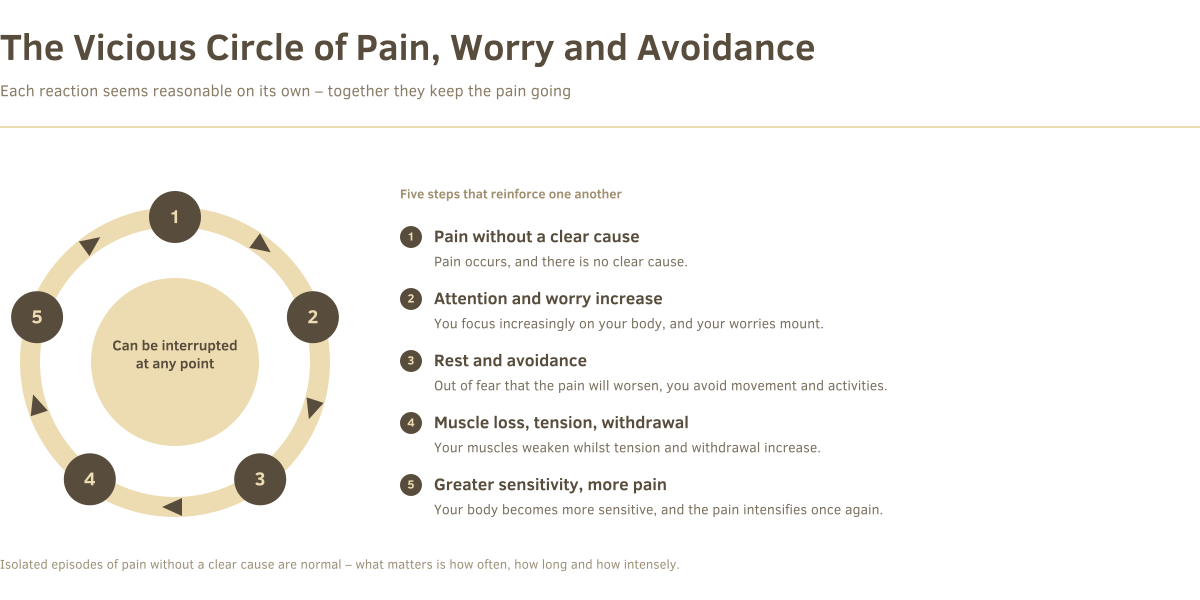
The Vicious Circle of Pain, Worry and Avoidance
You may find yourself caught in a cycle that perpetuates the pain, even though each individual reaction may seem reasonable at first. It often unfolds in the following stages:
- Pain occurs, and there is no clear cause.
- You focus increasingly on your body, and your worries mount.
- Out of fear that the pain will worsen, you avoid movement and activities.
- Your muscles weaken whilst tension and withdrawal increase.
- Your body becomes more sensitive, and the pain intensifies once again.
This dynamic is not a personal failure, but a well-documented mechanism that can be interrupted at several points.
Link to Depression and Anxiety
Pain and mood influence one another. Persistent symptoms can cause feelings of low mood and anxiety; conversely, depression and anxiety disorders can intensify your perception of pain. According to gesund.bund.de, around half of people with functional physical symptoms develop depressive symptoms or anxiety disorders. Psychosomatic pain associated with depression is therefore always taken into account in the diagnostic process.
If your pain is accompanied by feelings of hopelessness or thoughts of not wanting to live any longer, it is important to seek help quickly. The German out-of-hours medical service can be reached on 116 117, and the German telephone counselling service (Telefonseelsorge) is available round the clock on 0800 111 0 111. In acute emergencies, dial 112.
Somatoform Pain Disorder in Children and Adolescents
Children and adolescents can also experience pain for which no adequate physical cause can be found. The most common symptoms are recurrent stomach aches and headaches. Younger children are often not yet able to put their inner tension into words – in a sense, the body then takes over the role of speaking for them. The symptoms are real for the child and should never be dismissed as an excuse.
Only an examination by a paediatrician and a child and adolescent psychotherapist can determine whether a child has a somatoform disorder.
Stomach Aches and Headaches as a Sign of Stress
Recurrent pain in children often occurs in specific situations. Some children complain of stomach ache mainly in the mornings on school days, whilst the symptoms subside at weekends and during the holidays. For others, the pain becomes more frequent before separations – such as sleepovers or school trips – or during periods of family stress such as arguments, moving house or a parent’s illness.
Such patterns may indicate school anxiety or emotional disorders, in which physical symptoms are often part of the picture. At the same time, a single bout of stomach ache before a maths test is normal. You should take notice if the symptoms recur over a period of weeks and significantly restrict your child’s daily life.
How Parents Can Support Their Child
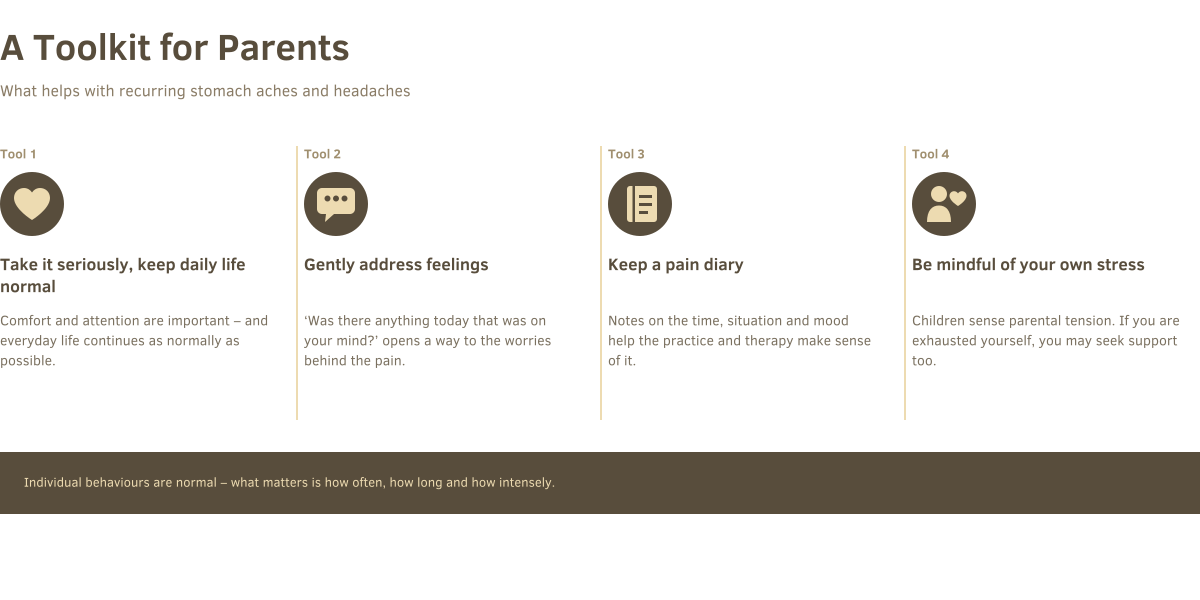
Parents have a major influence on how a child copes with recurring pain. The following approaches are particularly helpful:
- Take the symptoms seriously without reinforcing them
Comfort and attention are important; at the same time, it helps to let everyday life continue as normally as possible. - Gently address feelings
Questions such as ‘Was there anything today that was on your mind?’ open up a way to understand the worries behind the pain. - Keep a pain diary
Notes on the time, situation and mood help specialists at the paediatric practice and in therapy to make sense of the situation. - Be mindful of your own stress
Children are very sensitive to their parents’ tension. If you are suffering from pain or exhaustion yourself, you are allowed to seek support too.
Diagnosis and Treatment: What Helps with Psychosomatic Pain
The treatment of a somatoform pain disorder begins with a thorough diagnostic assessment that takes both physical and psychological aspects into account. The aim is not to ‘explain away’ the pain, but to develop a shared understanding of what triggers and sustains it. Treatment is then based on this understanding and combines several approaches.
How Is a Somatoform Pain Disorder Diagnosed?
Diagnosis usually follows a step-by-step process:
- Detailed consultation: The course of the pain, living circumstances, stressors and previous treatments are discussed.
- Physical examination: This clarifies whether there are any indications of a physical illness requiring treatment.
- Targeted additional tests: Laboratory tests or imaging are used where they help to clarify the situation – not as many as possible, but the appropriate ones.
- Psychosocial assessment: Mood, stress levels, anxieties and life history are taken into account, often supplemented by standardised questionnaires.
- Joint evaluation: The results are discussed in an accessible manner and a treatment plan is agreed.
More tests are not automatically better: according to gesund.bund.de, the risk of false positive findings increases with every additional test, causing unnecessary anxiety.
An Overview of Therapeutic Approaches
In the case of a somatoform pain disorder, it is usually not a single measure that is effective, but a combination of several components. Psychotherapy is usually at the heart of treatment. Cognitive behavioural therapy helps you recognise the connection between thoughts, feelings and pain, and develop new coping strategies. Depth psychology approaches can be useful if underlying conflicts or distressing experiences are involved.
Moderate exercise helps reduce avoidance behaviour, whilst relaxation techniques and mindfulness exercises reduce inner tension. Medication can provide temporary relief, but is usually of only limited help in the long term.
Overcoming Psychosomatic Pain – What You Can Do Yourself
Taking steps on your own is no substitute for treatment, but can effectively complement it. It is helpful to remain active despite your symptoms, to maintain social contacts and to recognise early on when you are becoming overburdened. Set yourself small, achievable goals and observe what alleviates your symptoms. Progress is often gradual.
Verus Bonifatius Clinic: Treating the Body and Mind Together
The Verus Bonifatius Clinic in Bad Salzschlirf treats functional and psychosomatic disorders in adults with a holistic approach that considers physical and psychological aspects together. The process begins with a thorough medical history taken during a consultation with a doctor. This involves checking whether physical causes have been adequately investigated, whilst also taking into account any existing or previous mental health conditions. Further medical examinations are carried out where necessary.
Based on this, a personalised treatment plan is drawn up, combining various therapeutic elements. Depending on the symptoms, these may include:
- Behavioural therapy (individual and group)
Helps to recognise pain-related thoughts, avoidance behaviours and stress triggers, and to gradually change them. - Depth psychology (individual and group)
Focuses on inner conflicts and life experiences that may be linked to the symptoms. - Problem-centred group therapy
Enables patients to share experiences with others facing similar challenges and eases the feeling of being alone with the symptoms. - Body awareness, mindfulness, progressive muscle relaxation
Helps to perceive bodily signals in a more nuanced way and to regulate tension at an early stage. - Body, art and music therapy
Opens up non-verbal avenues to feelings that are difficult to put into words. - Family therapy intervention
Involves family members when family pressures are a factor or when pain shapes everyday family life.
Where necessary, medication can be used as a complementary treatment. A special feature of the clinic is that parents can bring their child with them whilst they are undergoing treatment themselves. The clinic’s own child companionship looks after the children during therapy sessions, so that parents can concentrate on their treatment without the family being separated.
Find out which admission requirements apply to a stay at the Verus Bonifatius Clinic.
FAQs
Is Psychosomatic Pain Just in Your Head?
No. Psychosomatic pain is real and is experienced with the same intensity as pain with clear physical causes. The difference lies in how it arises and is maintained: stress, emotions and experiences alter the way pain is processed in the nervous system. The fact that no tissue damage is found does not, therefore, mean that the pain has no cause. Treatment therefore addresses both the body and the mind.
Can a Somatoform Pain Disorder Be Cured?
The course of the condition varies from person to person. With appropriate treatment, many people experience significant relief, greater mobility and a better quality of life, even if the pain does not always disappear completely. It is important to set a realistic goal: rather than focusing solely on becoming pain-free, the aim is to lead a more active everyday life despite the symptoms. Generally speaking, the earlier treatment begins, the easier it is to change established patterns.
Is There a Test for a Somatoform Disorder?
There is no single test that can definitively diagnose a somatoform disorder. Specialists use standardised questionnaires to assess the impact of physical symptoms, combining these with a consultation and a physical examination. Online self-tests can provide a starting point, but they are no substitute for a proper diagnosis. A diagnosis is only made by a medical or psychotherapeutic professional once physical causes have been adequately ruled out.
Note: This article is for general information purposes only and is no substitute for medical or psychotherapeutic diagnosis and treatment.
Published on: 13.11.2026